2026–27 Federal Budget: What It Means for Individuals and Small Businesses
Robert
May 29, 2026
The 2026–27 Federal Budget has been released, and there are several tax and business measures worth keeping an eye on.
While some announcements are still subject to becoming law, the Budget gives a clear indication of the Government’s direction: more tax relief for individuals, cash flow support for small businesses, and some significant proposed changes to investment tax rules.
Here are the key points.
Personal income tax cuts
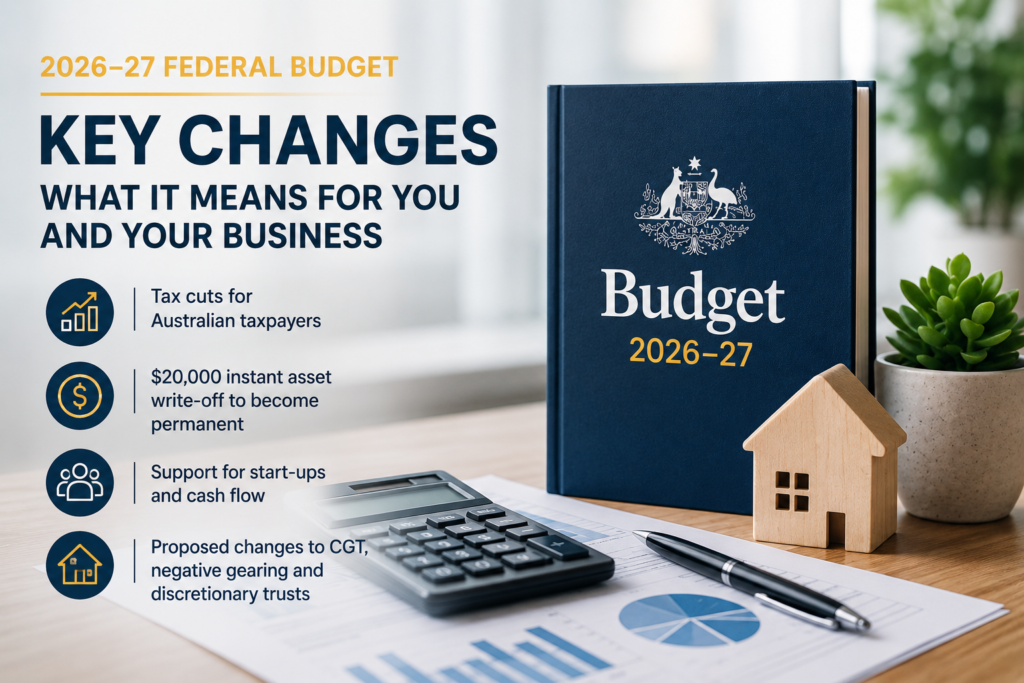
From 1 July 2026, the tax rate that applies to taxable income between $18,201 and $45,000 is proposed to reduce from 16% to 15%.
From 1 July 2027, this rate is proposed to reduce again from 15% to 14%.
According to the Budget papers, this means every Australian taxpayer could receive a tax cut of up to $268 from 1 July 2026, increasing to up to $536 each year from 1 July 2027, compared with the 2024–25 tax settings.
$20,000 instant asset write-off to become permanent
A major announcement for small businesses is that the $20,000 instant asset write-off is proposed to become permanent from 1 July 2026.
This measure applies to small businesses with aggregated turnover of less than $10 million. Eligible assets costing less than $20,000 can be immediately deducted, rather than depreciated over several years. The ATO notes that the $20,000 threshold applies on a per asset basis, meaning multiple eligible assets may be written off.
For small businesses, this can be useful for planning equipment purchases, technology upgrades, tools, office equipment and other business assets.
However, it is important to remember that the write-off reduces taxable income — it does not mean the asset is free. Businesses should still make purchases based on genuine commercial need and available cash flow.
Support for start-ups and business cash flow
The Budget also includes measures aimed at helping newer businesses manage cash flow.
From 2028–29, small start-up businesses in their first two years of operation may be able to access loss refundability, allowing certain tax losses to be refunded up to the value of fringe benefits tax and withholding tax paid on employee wages. The Government estimates this could benefit up to 25,000 young companies each year.
There are also broader measures aimed at improving investment and innovation, including changes connected with the R&D Tax Incentive and venture capital investment.
Proposed changes to CGT, negative gearing and discretionary trusts
One of the most significant areas of the Budget is the proposed reform to capital gains tax, negative gearing and discretionary trusts.
These changes are not just relevant to large investors. They may affect small business owners, property investors, family trusts and anyone using a discretionary trust as part of their investment or business structure.
Capital gains tax changes
From 1 July 2027, the Government proposes to replace the current 50% CGT discount with an inflation-based system.
Currently, individuals and trusts can generally reduce a capital gain by 50% where the asset has been held for more than 12 months. Under the proposed new rules, the discount would instead be based on inflation, so that tax is paid on the “real” gain after allowing for inflation. The Government has also proposed a minimum 30% tax rate on capital gains. The new rules are intended to apply only to gains accruing from 1 July 2027 when the asset is eventually sold.
This means the timing of asset sales may become more important. For example, a taxpayer selling a property, business asset or investment portfolio after the start date may need to consider how much of the gain relates to the period before and after 1 July 2027.
Investors who buy new builds will have some flexibility, with the ability to choose between the existing 50% CGT discount and the new inflation-based arrangements.
Negative gearing changes
The Budget also proposes changes to negative gearing for residential property.
From 1 July 2027, negative gearing for residential property will generally be limited to new builds. Existing properties held before 7:30pm AEST on 12 May 2026 are proposed to be grandfathered, meaning the existing rules should continue to apply to those properties.
For investors who purchase established residential property after Budget night, losses may still be deductible against residential property income, including capital gains, and unused losses may be carried forward. However, those losses would generally not be deductible against other income such as salary and wages.
This could have a major cash flow impact for investors who rely on rental losses to reduce tax on their employment or business income.
Discretionary trusts
The Budget also includes a proposed 30% minimum tax rate for discretionary trusts from 1 July 2028, with some exceptions.
This is a significant change because discretionary trusts are commonly used by family groups and small business owners for asset protection, succession planning and flexibility in distributing income.
At the moment, trust income is generally taxed in the hands of the beneficiaries who are made presently entitled to that income. This means the final tax outcome depends on each beneficiary’s marginal tax rate and circumstances.
Under the proposed changes, discretionary trusts may be subject to a minimum tax rate of 30%. This could reduce the tax advantage of distributing income to adult beneficiaries on lower tax rates, particularly where trust distributions have historically been used to manage tax across a family group.
What this means for family trusts and small business owners
For family groups using discretionary trusts, the proposed changes may affect:
- investment property structures;
- whether new investments should be made inside or outside a trust;
- distribution planning from 1 July 2028;
- the after-tax benefit of distributing income to lower-income adult beneficiaries;
- long-term asset sale planning;
- business succession planning;
- asset protection structures; and
- whether existing trust structures are still appropriate.
Importantly, the Government has also announced that rollover relief will be available for three years from 1 July 2027 to assist small businesses and others that wish to restructure.
That does not mean every trust should be wound up or restructured. Discretionary trusts may still have important commercial, succession and asset protection benefits. However, the proposed tax changes mean existing structures should be reviewed rather than assumed to remain tax-effective.
Practical example
A family trust that owns an investment property may be affected in several ways.
If the property is an established residential property acquired after Budget night, negative gearing benefits may be restricted. If the property is sold after 1 July 2027, the CGT outcome may be calculated under the proposed new rules rather than the current 50% discount system. From 1 July 2028, income distributed through the discretionary trust may also be subject to the proposed 30% minimum tax rules.
For some taxpayers, the trust may still be appropriate. For others, the tax cost may be higher than expected.
What should you do now?
The key message is not to panic, but to plan early.
Before buying or selling major assets, changing investment structures or distributing trust income, it is worth reviewing your position. This is especially important if you operate through a family trust, hold investment properties, or are considering selling a business or investment asset in the next few years.
As these measures are still subject to legislation, the final rules may change. However, given the potential impact, taxpayers should start considering the effect on their structures now.