
Beyond the Tax Cuts: The 2026–27 Budget Changes Property Investors and Business Owners Need to Watch
Robert
July 30, 2026
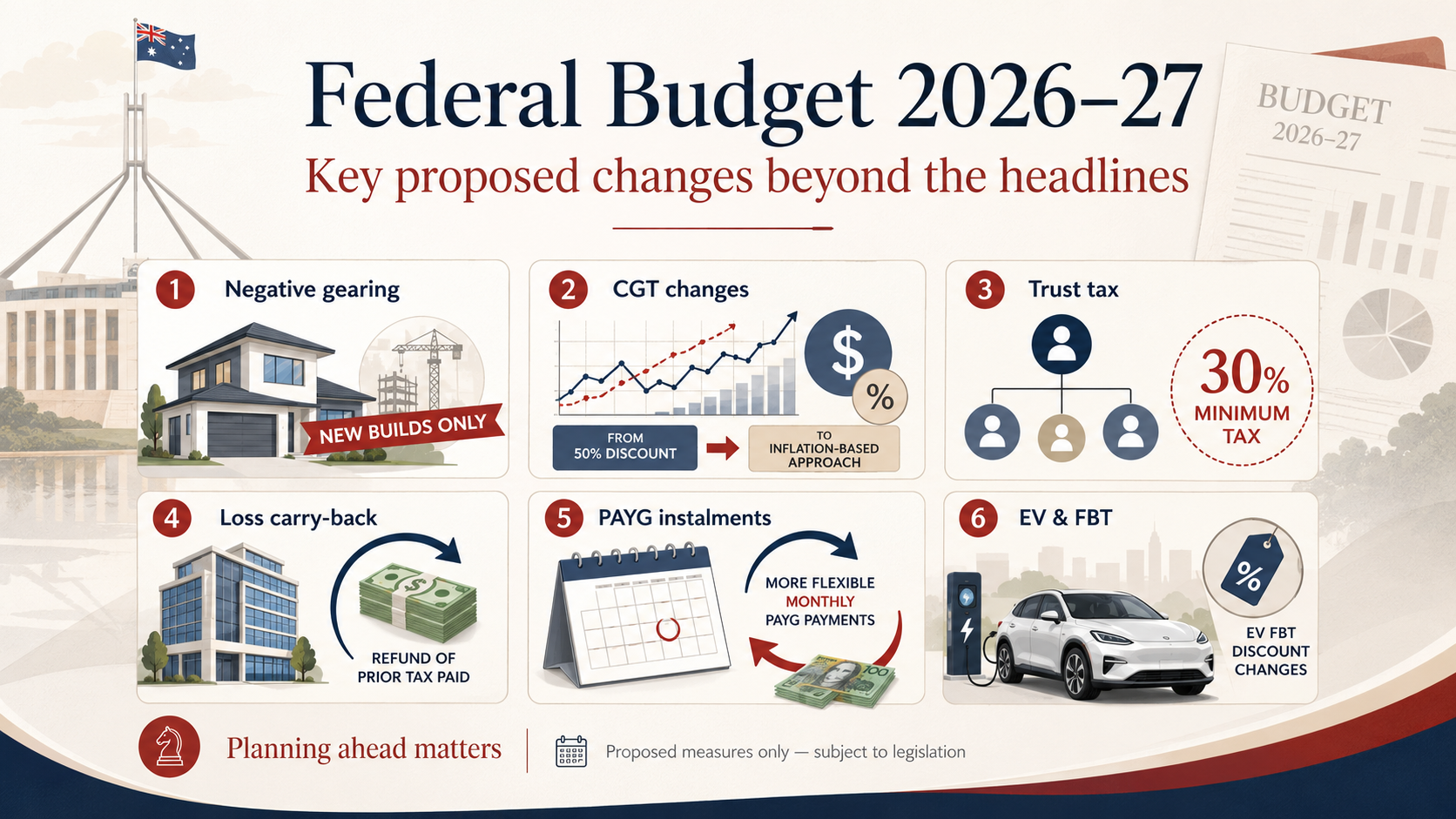
Our earlier article covered the headline personal tax cuts and the permanent $20,000 instant asset write-off from the 2026–27 Federal Budget. But some of the Budget’s most consequential proposals sit beneath those headlines — and they’re the ones most likely to affect anyone who owns an investment property, runs a business, or holds assets through a trust. Here’s what deserves your attention, with the important caveat that these are proposed measures with future start dates, and several must still pass Parliament before becoming law.
Negative gearing to be limited to new builds
From 1 July 2027, negative gearing is proposed to be limited to newly built properties. Existing arrangements would remain unchanged for any property held before Budget night, so if you already own an investment property, your current position is protected under the proposal.
For anyone buying established housing after Budget night, the rules would tighten. You could still deduct rental losses against income from residential property and carry forward any unused losses to future years, but you would no longer be able to offset those losses against other income such as your salary. If you’re weighing up a property purchase, the distinction between new and established stock suddenly matters a great deal.
A new approach to capital gains tax
Alongside negative gearing, the Budget proposes replacing the longstanding 50% capital gains tax discount with a discount based on inflation, together with a minimum 30% tax on gains. These changes would apply to gains arising after 1 July 2027, and investors in new builds would be able to choose between the current 50% discount and the new arrangements.
The practical effect is that CGT would be calculated on your real gain after inflation rather than a flat halving of the nominal gain. For assets held over long periods, this is a meaningful shift, and it makes the timing of any future sale worth discussing well in advance.
A minimum tax on discretionary trusts
If you distribute income through a family or discretionary trust, this one is important. The Budget proposes a minimum 30% tax on discretionary trust income from 1 July 2028, with some exceptions. To help affected businesses adjust, three years of rollover relief is proposed from 1 July 2027 for those who wish to restructure.
Trust structures are common among the small businesses and families we work with, and the right response will depend heavily on your circumstances. If this applies to you, it’s far better to map out your options during the transition window than to be caught out later.
Loss carry-back returns for companies
There’s welcome news for company owners. From 2026–27, the Budget proposes reintroducing loss carry-back, allowing an eligible company that makes a loss to claim a refund against tax it paid in the previous two income years. The Budget estimates this could benefit up to 85,000 companies, most of them small businesses.
For a company that has a strong year followed by a lean one, this can turn a current-year loss into a genuine cash refund — a valuable cash-flow lever, particularly for businesses investing in growth or navigating a tough trading period.
More flexibility on PAYG instalments
Cash flow gets another boost. From 1 July 2027, businesses are proposed to have the option to move to monthly PAYG instalments when conditions change, rather than being locked into quarterly amounts that may no longer reflect reality. Paired with an expansion of the ATO’s dynamic instalments approach using business software, the aim is to keep instalments closer to what a business actually owes.
Electric vehicles and the FBT discount
Finally, if an electric vehicle is on your radar as a business or salary-packaged car, the settings are changing. The current fringe benefits tax exemption for electric cars is proposed to transition to a permanent 25% FBT discount — applying to eligible EVs over $75,000 from 1 April 2027, and to all eligible EVs from 1 April 2029. Electric cars costing up to $75,000 would keep the full FBT exemption, provided the arrangement begins before 1 April 2029. In short, there’s a window where the more generous treatment still applies, so timing matters.
Where to from here
None of these measures are law yet, and the detail can change as legislation is drafted. But the direction is clear, and several of these proposals — especially around property, trusts and CGT — reward early planning rather than a last-minute scramble. Decisions you make now about buying, selling or restructuring could look quite different once these rules take effect.
If you’d like to understand how any of these proposed changes could affect your investments, your business or your trust arrangements, the team at Brick Road Accounting is here to help you plan ahead with confidence.
This article is general information only and does not constitute financial or tax advice. The measures described are proposals from the 2026–27 Federal Budget and may change before becoming law. Please speak with us for advice specific to your situation.
Recent Post
Dont Hesitate To Contact Us
Have a question about your tax, accounting, or business needs? Our team is here to help. Get in touch today.