Owe the ATO? Why Your Tax Debt Just Became Your Most Expensive Debt
Robert
November 27, 2026
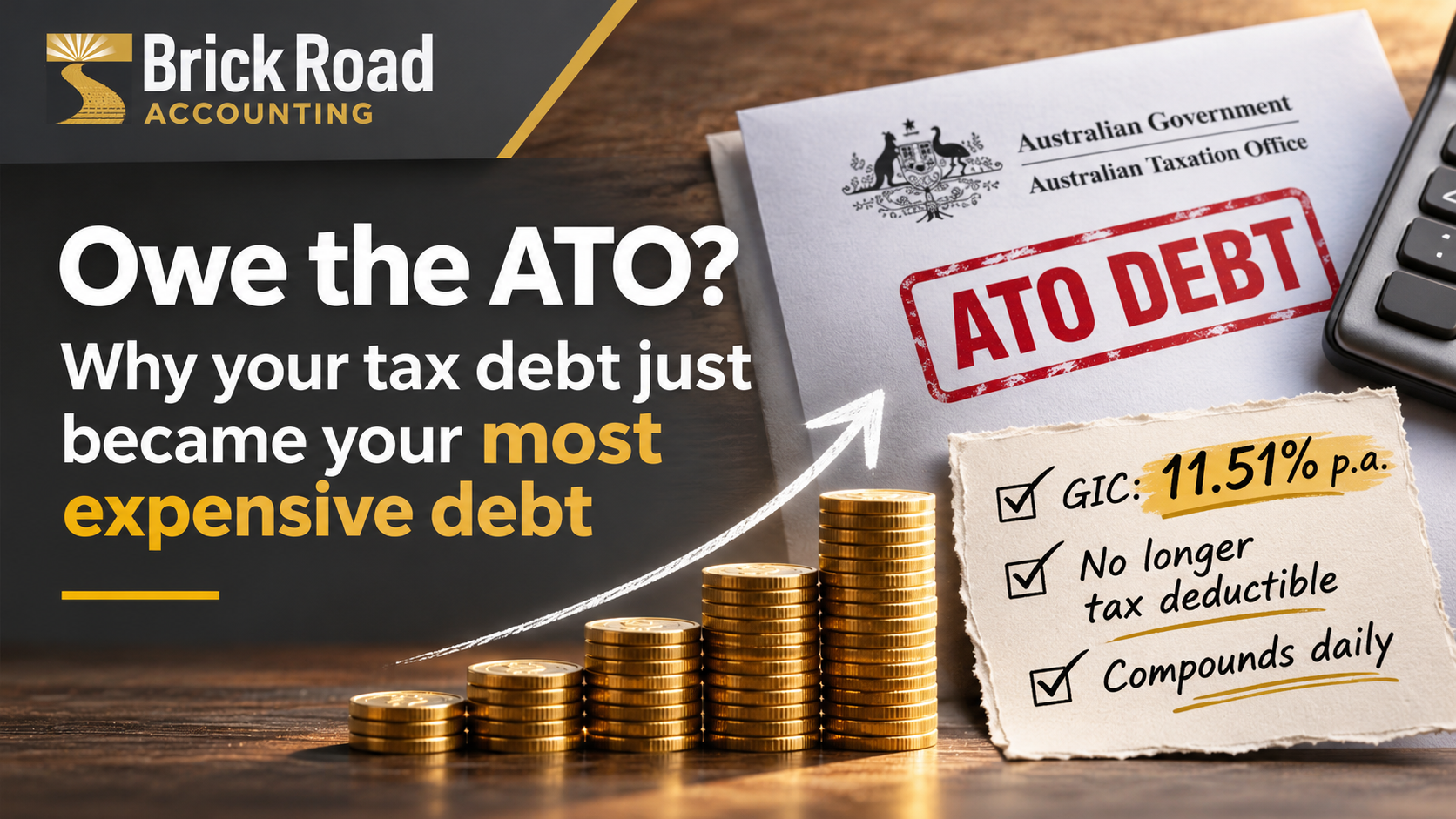
For years, plenty of small businesses quietly treated the ATO as a line of credit. Cash was tight, the BAS could wait, and the interest the ATO charged was at least tax deductible. That last part has changed, and it makes carrying a tax debt far more costly than most people realise.
What changed
From 1 July 2025, the general interest charge (GIC) and shortfall interest charge (SIC) are no longer tax deductible. This is now law, and it applies to any GIC or SIC incurred on or after 1 July 2025, whether you’re a sole trader, partnership, company or trust.
Interest charged before 1 July 2025 can still be claimed in your 2024–25 or earlier returns. Anything from 1 July 2025 onwards can’t be claimed at all.
What GIC actually costs
GIC is what the ATO charges when a tax debt isn’t paid on time: a late BAS payment, an unpaid income tax assessment, or a PAYG instalment that slipped. For October to December 2026, the GIC rate is 11.51% per year, and it compounds daily.
SIC applies when an amended assessment increases your tax. It’s lower, at 7.51% for the same quarter, but it is also no longer deductible.
A quick example: a $20,000 debt left unpaid for 12 months at the current rate would pick up around $2,440 in GIC. Before the change, a company could claim that as a deduction, which softened the cost. Now the full amount comes out of your pocket, with no tax benefit at all.
Compare that with a business overdraft or loan, where the interest is generally deductible against business income. On an after-tax basis, the ATO has gone from being a cheap lender to being one of the most expensive.
Why this matters right now
December and January are tough months for cash flow. Trade slows, staff take leave, Christmas costs land, and quarterly BAS and PAYG instalments keep coming. It’s exactly when people are tempted to let a tax payment slide.
If you do, the interest now builds faster than most other debts you hold and can’t be claimed back at tax time.
Practical steps to get on top of it
1. Put tax payments high on the list. If you have to choose which bill waits, the ATO is rarely the right one any more. Paying down tax debt first is often the best “return” available.
2. Lodge on time, even if you can’t pay. Late lodgement brings its own penalties on top of GIC, and it limits your options. Lodging on time keeps you in a far stronger position to negotiate.
3. Set up a payment plan early. A payment plan doesn’t stop GIC, but it shows the ATO you’re engaging. That matters for collection action and for any later request to have interest reduced. Many plans can be set up online through the business or tax agent portal.
4. Ask whether refinancing makes sense. For some businesses, using a business loan or overdraft to clear tax debt is cheaper, because that interest can generally be deductible. Whether it is for you depends on your structure and what the debt relates to, so talk to us before you refinance.
5. Ask for a remission if you have a good reason. The ATO can remit (reduce or cancel) GIC where there are circumstances outside your control, such as illness, natural disaster or a delay on the ATO’s side. Remitted GIC incurred from 1 July 2025 doesn’t need to be included as income.
6. Set money aside as you go. The simplest fix is to avoid the debt in the first place. A separate account for GST, PAYG withholding and instalments, topped up each week or each time you’re paid, takes the sting out of BAS time.
A note on remitted interest from earlier years
If you claimed GIC as a deduction before 1 July 2025 and the ATO later remits it, the remitted amount still needs to be included as assessable income in the year the remission happens. It’s worth keeping in mind if you have an older debt still being negotiated.
How we can help
If you have an ATO debt, or you’re worried about the next BAS or tax bill, it’s much easier to sort out early than late. We can review what you owe, talk to the ATO for you, set up a payment plan that works for your cash flow, and help you build a simple system so the next bill doesn’t sneak up on you.
Brick Road Accounting works with individuals and small businesses in the suburbs between Brisbane and the Gold Coast, from Ormeau and Pimpama to Coomera, Beenleigh and Logan. Get in touch for a chat about where you stand.
This article is general information only and doesn’t take your personal circumstances into account. Rates quoted are the ATO’s published rates for October to December 2026 and change quarterly. Please speak with us before acting on it.
Dont Hesitate To Contact Us
Have a question about your tax, accounting, or business needs? Our team is here to help. Get in touch today.